I once worked and lived in Indonesia’s capital Jakarta where I hooked up a British woman who was of similar age, with a similar professional background so we had much in common. That common background and comparable experiences enabled a quick transition from acquaintances, to solid friendship. Mel was a good looking women with flaming red hair, a quick turn of phrase and a wicked sense of humour. However, one significant difference was that she had a Romanian husband, who happened to be more than 15 years her junior. This kept Mel permanently obsessed in trying to look younger so that the husband wouldn’t stray. She had sourced and investigated every plastic surgeon, nail technician, beautician, dietician and hairdresser within a 100 kilometre radius of Jakarta. When we would meet socially at weekends, she would regale me with blow-by-blow details of lotions, potions, cures and the cost of the latest available treatments.
An extensive choice of therapies and treatments is typical of most Asian countries, where many of the wealthy classes are preoccupied with enhancing beauty and maintaining youthful looks. It’s also a region where you’re as likely to walk into a beauticians and find more men than women having deep facial cleansing; for some reason I was always felt more than a little uncomfortable lying on a therapist’s bed beside a strange man….I digress. The wide choice of available treatments is matched only with an equally generous selection of charlatans offering therapies.
I arrived one day to meet Mel holding an airline magazine with a story about some therapy that didn’t require surgical intervention. When I showed it to her she dismissed the article and began to rave about one particular acupuncturist who held a practice on the other side of the city. Mel swore that after attending his clinic several times she dropped a full dress size. In addition, this miracle man could tighten sagging facial skin using acupuncture – in other words, a face lift without a scalpel.
My curiosity was sparked and Mel suggested we make an appointment. Battling my weight since childhood, losing a dress size was always met with keen interest. I couldn’t believe my luck that there was also the additional bonus of a face lift without a scalpel and that there may be a ‘cure’ for an increasingly severe nerve pain in my foot, where I had suffered a fracture a few years previously.
Mel booked an early Saturday morning appointment so we could avoid some of Jakarta’s notorious traffic. When we arrived, I’m not sure what I expected to find, but was taken aback to find a room was packed with about 30 therapists beds, with just enough space between each bed to allow the acupuncturist move between clients. I couldn’t have been closer to these strangers if we were sleeping in the same bed.
Pins and needles
With my limited Bahasa Indonesian and his limited English I explained that I wanted to lose a few kilogrammes and would be very happy to reduce the (ahem), laughter lines on my face. I was asked to expose my belly, so opened the zip on my jeans. The acupuncturist proceeded to place needles all over my tummy before inserting more needles in my jaw and around my eyes. In a room packed full of Muslim women, still holding onto their modesty by wearing hijabs ensuring their hair was not exposed to a strange male, but all exposing pin-filled bellies and covered with needles sticking out of their face, the absurdity wasn’t lost on me.
I felt like a voodoo doll once I was all pinned up and proceeded to explain the pain I was experiencing from the pinched nerve in my foot. The therapist nodded sagely, then making a circle with his thumb and middle finger, he looked through the circle as if it was a magnifying glass, moving up and down my leg before honing in on the problem area of my foot. Raising his index finger in the air he announced there was a devil living inside my leg and it would need to be exorcized. I could see several heads raised on the beds with curiosity as the therapist began sucking in deep breaths over my foot, throwing his head back, he exhaled deeply with his head angled towards the ceiling and repeated this action several times. From my reclined position all I could see was the pin-filled bellies of the other women shaking as the supressed giggles could no longer be supressed and rose to full-blown belly laughing.
Bathroom scales
Despite being the source/object of such great hilarity, I dismissed any feelings of embarrassment and returned for further ‘treatment’ two weeks in a row. On the fourth Saturday when the bathroom scales had somehow stubbornly stuck on the same weight, I tackled the therapist asking when I could expect to see some weight loss. “Do you eat dinner?” he asked. “Of course, I eat my dinner,” I responded indignantly. When he suggested that in order to see some results I was to skip dinner, I decided at this point, enough was enough. I was paying out good money to have needles stuck in my tummy every Saturday morning to lose weight when all along it was just a simple matter of….skipping dinner? It was the skipping dinner suggestion that helped in my decision not to return and waste energy sitting in Jakarta traffic each Saturday morning.
I eventually managed to achieve a small measure of success in the weight loss department by eating less and exercising more, without the need for acupuncture. I have to admit though, the laughter lines multiplied in the proceeding years, so much so that my face could be mistaken for a map of Ireland, without makeup for camouflage.
Funny thing was the nerve pain in my foot miraculously disappeared, never to come back again.
Mel and I had several more adventures before I moved on to work in other countries and we lost touch. Mel managed to track me down several years later on social media. Our lives had taken different paths but we kept in touch. She had however, lost the battle to hold on to the younger husband. No amount of pins, potions or lotions could save the marriage when the Romanian found a young lover and discarded Mel like a used acupuncture needle.
PS Mel returned to the UK and sadly succumbed to breast cancer in the summer of 2020. She was a sweet, gentle soul who was a great friend and a great source of entertainment in an otherwise big and lonely city. May she rest in peace.
When I was working, I was privileged enough to visit several of the ‘Stans’; Pakistan, Afghanistan, Tajikistan and in October 2024, I went on an assignment as an election observer to Uzbekistan. Located in Central Asia, Kazakhstan lies to the north, Kyrgyzstan to the northeast, Tajikistan to the southeast, Afghanistan to the south and Turkmenistan to the southwest. Uzbekistan is one of two countries in the world that is doubly landlocked, meaning it’s surrounded by countries that are also landlocked. The only other country with the same geographical anomaly is Lichtenstein in central Europe.
I arrived to Tashkent, the capital of Uzbekistan as part of an election observer team, a few days prior to polling day. Autumn was in full swing and apparently the height of the tourist season – (summer temperatures rise to 40 degrees Centigrade and by all accounts, unbearable). With so many tourists in town, we were asked to share a hotel room with a same sex observer who was also part of team covering our assigned area in Jizzakh. To say some people had a hissy fit at being asked to share a room would be an understatement; although the terms of reference for short term observers stipulates that flexibility is a core requirement and conditions may not always be desirable. One Polish ‘diplomat’ packed her bags and fled in the middle of the night when she discovered she had to share a room. I got to share with a young, mini-skirt wearing Bangladeshi/German who, when she wasn’t coughing all night, could wake the dead her snoring was so loud. When my earplugs didn’t stop the din of the snoring or coughing, the next morning I asked her to visit the pharmacy for a cough suppressant, so she stopped speaking to me. Although I was the only Irish person staying in the Hotel Ramada, I wasn’t short of company and got to hang out with Tara (the Tory). The ideology of the Tory party in the UK is possibly the direct opposite of my own political beliefs so I never imagined that I would enjoy the company of somebody who was a member of the Conservatives. I do think that Tara was a bit confused about her political loyalty and was more of a social democrat when you scratched the surface. Her saving grace was that she had voted to remain in Europe, rather than voting for Brexit so the Irish contingent had no issue in including her for dinner and extracurricular activities.
Modern Tashkent
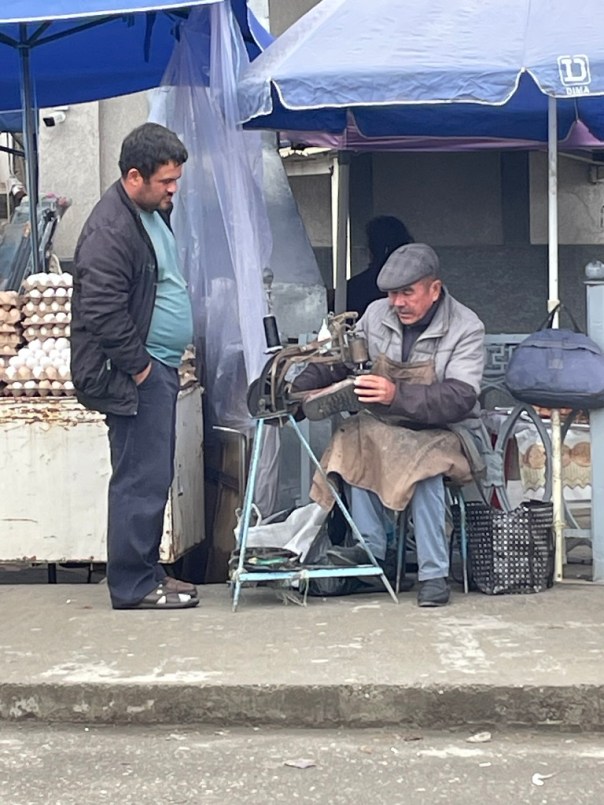
The flight from Dublin was more than 12 hours if you took into account the stopover in Istanbul (my least favourite airport in the world). After a long night’s travel and with little sleep, most of us took a short nap after we checked in. In the early afternoon Tara, myself and another Irish woman headed out to explore some of Tashkent. The hotel ordered the taxi and we made our first stop at Chorsu Bazaar on the southern end of the old city. I felt a little disappointed as we wandered through the section where craftsmen (and hopefully women) sold instruments for making patterns on bread, handmade cots and toys for babies. Almost giving up because there wasn’t much to interest us, we crossed the road to the indoor section of the bazaar which was covered with a large dome, where we found ourselves in the meat section of the market.
Chorsu Bazaar, Tashkent
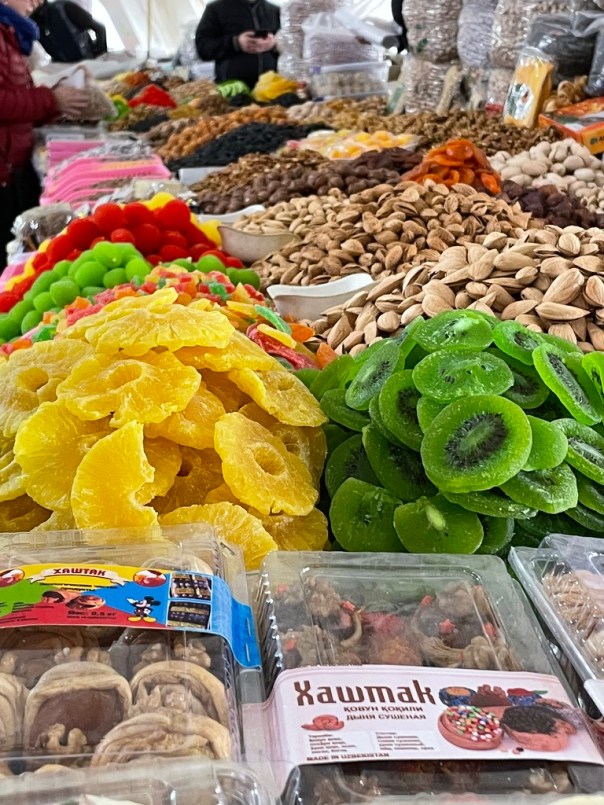
It was a vegetarian’s and vegan’s worse nightmare. Horse meat, liver, animal trotters – you name it, it was there, but the most surprising aspect was the absence of flies. Now I’ve been to dozens of African markets where the flies were so thick it was impossible to see the meat and if you did buy meat it had to be boiled for hours before there was any guarantee you wouldn’t end up on death’s door in a hospital with food poisoning. The upper floor of the bazaar was a treasure trove of dried fruits and a fabulous collection of spices, including saffron, the most expensive spice in the world with a retail value of around US$3,000 per kilo (depending of course on the availability and market rates). Saffron comes from the crocus sativus flower and the best quality and largest producer of the world’s saffron is Iran, although there is now a heavy investment in producing the flower and ergo spice in Uzbekistan.
Very few people speak English, so making our way around was challenging and we found ourselves wandering aimlessly, attempting to seek directions from locals at the market and failing miserably through our use of using sign language and finger pointing. We were fortunate though and ended up coming across a group of English tourists with a Uzbeki guide to point us in the direction of the Metro to meet up with the remainder of our group for dinner. One member of the tourist group kindly provided us with a metro map and loose instructions on the metro’s location. After wandering around the outdoor section of the market, we eventually found the elusive Metro. Perhaps it’s a symptom of having few visitors to the country but people stopped to help us everywhere. A random Uzbek woman took us under her wing and insisted on accompanying us to the station where we were to transfer to another line. With two of us being older ladies, passengers stood up to allow us sit down and wouldn’t take no for an answer. When we reached the transfer station, our unofficial female guide was pointing us in the wrong direction when a young man who had been listening to the lady, interjected, indicating that we were going the wrong way and accompanied us to the platform for our transfer. It was so refreshing to receive such hospitality and it was also a great opportunity to interact with the local people. It is often said that the Irish are friendly, but we are in the tuppence-halfpenny place by comparison to the hospitality and friendliness of the Uzbeks.
On day two of our mission we attended training and a briefing on our area of responsibility. It’s policy to match up a male and female observer from two different countries to work together. My previous observer mission was Ukraine in 2019 when Vladamir Zelensky was elected and I ended up with a gun-toting Trump supporter as a partner. To say we didn’t meet eye to eye is an understatement, he was trying to tell me that electricity created through windmills killed millions of birds and that it was a misnomer that oil damaged the environment (incidentally, he worked for the oil industry – quelle surprise). I thought at one stage he would burst a blood vessel he was so annoyed when I pointed out that his hero the B-rated movie actor Ronald Regan, suffered with Alzheimer’s and consulted a fortune teller for guidance while he was president of the US. Thankfully, my partner on this occasion was a Norwegian married to a Russian woman and living in Moscow. Lars works with Ukrainian refugees in Moscow and speaks fluent Russian, which proved very beneficial, but that wasn’t his only attribute; he was simply a very nice affable man with a sense of humour, which made him an excellent partner.
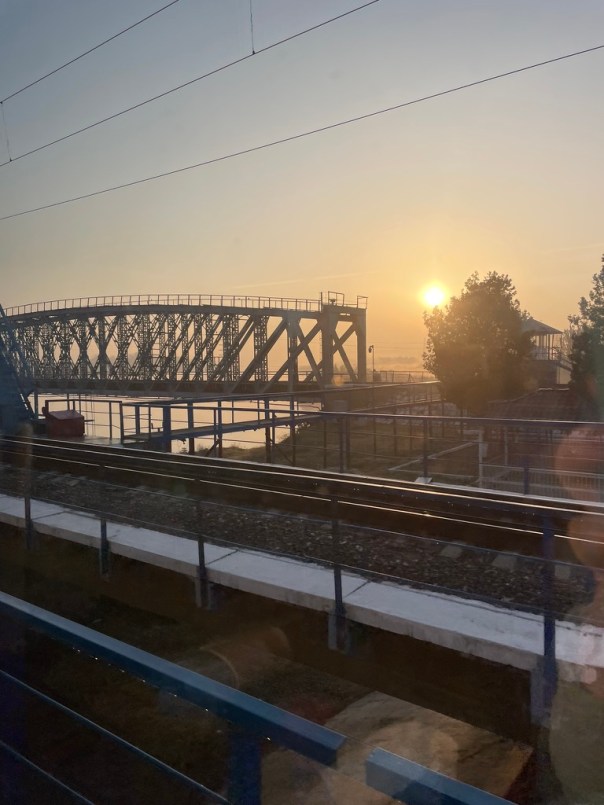
On day three we found our way to the train station for an early departure from Tashkent to Jizzakh. Catching a train in Uzbekistan involves checking in with a passport as proof of identity and where luggage is scanned at the entrance just like at the an airport, so a late arrival just adds unnecessary stress to the journey. We arrived in good time and took the 95 minute journey in a Russian-built train, that was super clean and super-efficient. As a coffee snob, I declined the free coffee that was delivered to all passengers with a free croissant, included in the price of the ticket. It was a terrific opportunity to see some of the countryside and get a sense of life for the average Uzbeki. The final destination was Samarkand, a further 30 minutes south and an extraordinary city with a big tourist draw.
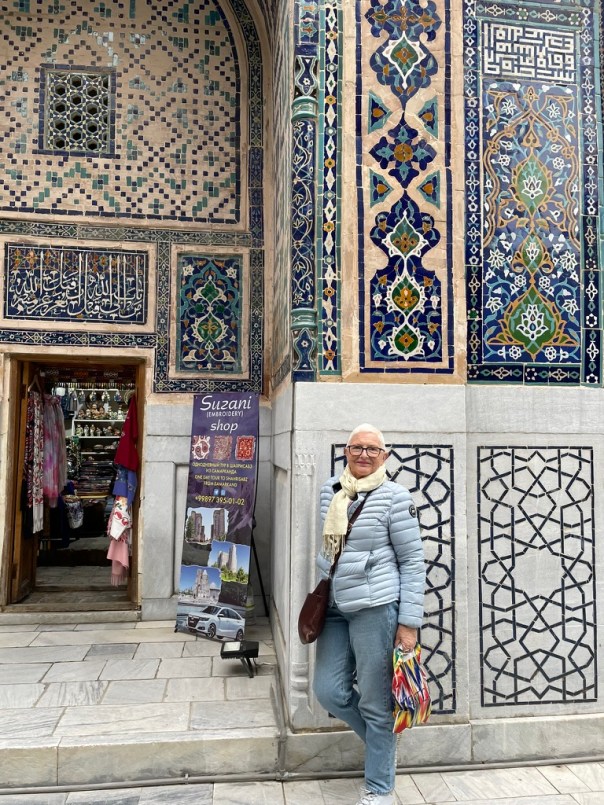
Samarkand Madrassa
We thankfully didn’t have to share a room in Hotel Za’faron in Jizzakh. The hotel was located in a business compound and the owners employed an international chef to cook some traditional Uzbek food. The food was excellent and I just couldn’t get enough of the pumpkin soup which is beyond delicious; so much so, I’d get up in the middle of the night to have a bowl of that soup given half a chance. As I mentioned earlier, a visit to Uzbekistan for a vegan or vegetarian would be almost impossible but what I found extraordinary was that I didn’t see one obese Uzbek person for the eight days of the trip. I can only put it down to the fact that the diet in Uzbekistan lacks the food additives found in processed foods in all supermarkets in the West, and most of the food we ate was made from scratch without the nasty chemical preservatives or palm oil.
The long-term observers who had worked for weeks before our arrival and managed our deployment, met us at the station. We transferred to our hotel to discuss the assignment and it was still only 11:30 when we finished the meeting and introduced to our driver and interpreter. The main spoken language is Uzbeki, with large numbers of the population also able to speak Russian. Indeed, our translator was a lecturer in the local university of Jizzakh where she taught English. Almost every town and village had English language schools, a sign that the country is working on expanding its opportunity to do business outside Asia. Without any official duties and rather than waste the remainder of the day, we took off for Samarkand to see what the big fuss of the tourist draw was about. While the trains were super comfortable and efficient, I couldn’t say the same about the roads. The distance between the two areas is just 100 kms and it took us the best part of 2.5 hours to reach Samarkand.
The weather gods were disappointing and we arrived to a cold and drizzling rain, but it didn’t take away from the magnificence of the three madrassas in Registan Square that have stood for centuries. The oldest madrassa is believed to date back as far as the 15th Century and these unique buildings are covered in fabulous tiles. Samarkand is more than 2,750 years old (one of the oldest cities in the world) and stands at the junction of the old trade routes. The sheer size and majesty of the three buildings draws wedding parties and engaged couples for photo opportunities, and it was interesting to see so many wedding parties gathered on the day we visited. Walking around the inside of the buildings, what were once classrooms and libraries for young boys to learn the Koran were turned into handcraft shops selling quality crafts where it was compulsory to bargain with the shop owners.
A happy newly-wed couple in Samarkand.
Our driver and translator were born and lived in Jizzakh. The driver worked in a local factory for his day job, taking leave to drive us for the few days. He was quite a handsome man but I was bemused when his smile revealed a bottom row of gold teeth. There may have been a time when gold teeth were fashionable, but like the current popular fashion of chemically puffed up lips that turn most women into something akin to Donal Duck, there’s nothing attractive about gold teeth. The driver wasn’t the only person I met with gold gnashers, one woman I came across appeared to have replaced every tooth in her head with a gold crown. There were days when I felt I was on on the set of a James Bond movie intreracting with all the baddies.
Our area of responsibility was around the town of Jizzakh and also partly in the countryside on the outskirts of the city. We spent the day before the election doing a recce, visiting the polling stations and introducing ourselves to the polling staff who were conducting final checks to ensure everything was in order. All of the polling stations we visited were schools and most were ultra modern. One newly built school we visited has the capacity for 1,600 students and as a new build with a new housing estate nearby, there are already 1,000 pupils enrolled. A very capable headmistress was chief of the polling station. At one stage during our visit I asked for the bathroom and was escorted down the corridor by one of the election workers. On my way back I peeked into a class room to see 20-25 tables laid out with chess boards and realised that chess is a subject like Geography or History in Uzbekistan. I was very impressed that school children are being taught strategic thinking from a young age – every school child should learn how to play chess!!
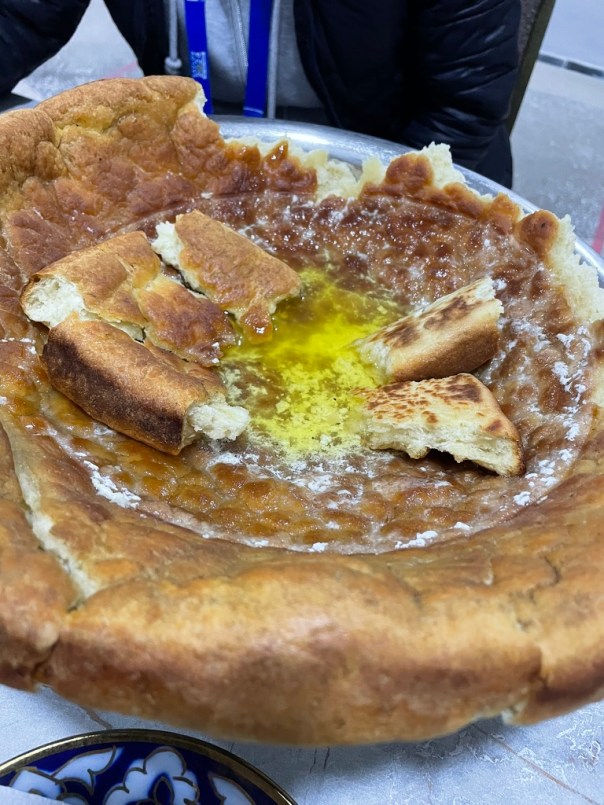
Like the Uzbeks we met in Tashkent, everybody was super friendly at the polling stations. When we arrived for a recce to our designated polling station to observe the count, the local head of the council insisted that we shared food and drink tea with him. The local fruits were really high quality and the melons and apples the sweetest I have ever tasted. On the night of the election we arrived at the polling station as darkness fell about 30 minutes before the end of voting. We wanted to observe how procedures were followed and how efficient was the balot count conducted. As night fell the room became cold and more food was brought in. This time it was hot bread in the shape of a bowl with a quarter kilo of butter melting in the centre –a heart attack on a plate! I picked at a corner of the bread ever mindful of my cholesterol levels and had a taste of the pastry wrapped around meat presented to us.
Hot bread with melting butter.
Once a rhythm was established for the vote count procedures it was obvious that the chief of the station had everything under control and it wasn’t his first time to organise a count. Some of the staff who had finished the count early for their assigned locality, succumbed to their natural curiosity and moved in our direction for a chat, or best described as more of an interview. When the men wanted to know where we were from, Lars mentioned he was Norwegian and I intimated I was Irish. There was a look of immediate recognition when they heard my nationality and in unison a group of five or six men said “aaah Conor McGregor.” I was so embarrassed that the Uzbeks related Ireland to this horrible man who was recently sued for the rape of a woman. It brought to mind one of one my late mother’s favourite sayings, “he’d bring out the sweat of shame on you,” and indeed I did feel mortified; Ireland has so much more to offer than the reputation of this awful individual.
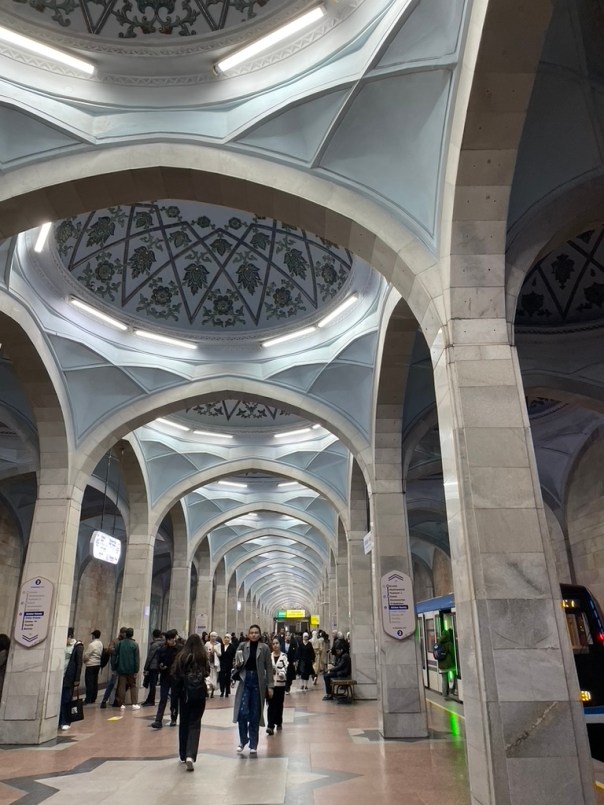
On our return to Tashkent, Lars had everything sussed out after completing some research including the metro system. His fellow Norwegian compatriot Emily, an undertaker by profession, were setting off for the day, so myself and some other Europeans stuck close by knowing that we didn’t need to spend half our day trying to find a translator or figure out the transport system. We went back to Chorsu Bazaar where some of the group set about finding silk scarves to bring home as gifts. I picked up some saffron and dried fruits for gifts and our next stop was to a leather shop two stops on the metro, well researched by the fabulous Lars. Kanishka was like an Aladdin’s cave of quality goods including belts, jackets, bags, key fobs, passport covers all with creative and unique designs. The metro, like the rail system was built by the Russians and really cheap and efficient. Some of the stations were just stunning, the most interesting being the station celebrating, Kosmonavtlar (Cosmonauts), is a space-programme-themed station, part of the Tashkent Metro. The murals on the station walls celebrate Soviet cosmonauts such as Yuri Gagarin and Valentina Tereshkova, the first man and woman in space.
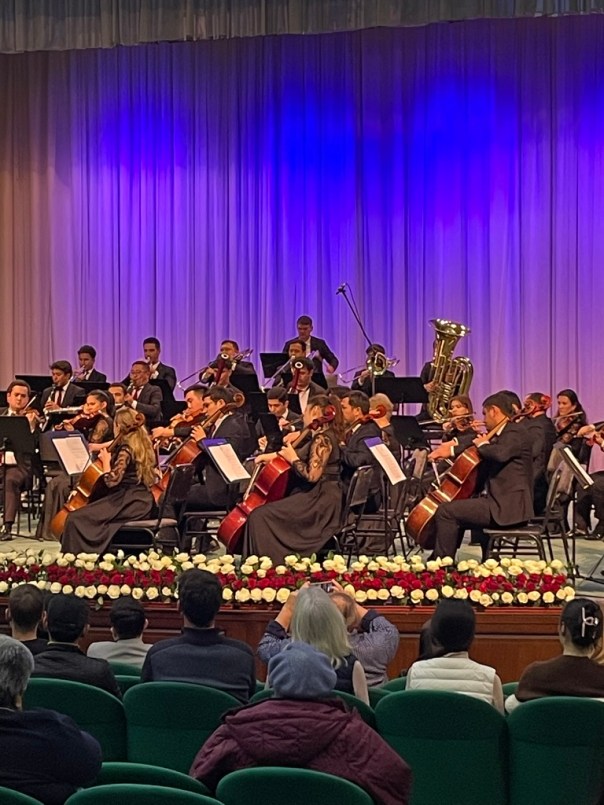
The Uzbek National Symphony Orchestra.
After the election debriefing and before dinner on our last evening we managed to make it to a recital of the Uzbekistan National Symphony Orchestra with performances by two female soloists, a cellist and violinist. For the princely sum of about €7.50 we were treated to 90 minutes of pure joy. Unlike most Western cultural orchestral events, the audience was made up of ordinary working class citizens, some on the way home from work, others were mothers who brought their children along and of course students of the school of music where the event was held.
I knew little about Uzbekistan before the assignment, although when I told friends, I heard of several people who recently made it there on vacation. While Uzbekistan is a largely Muslim country, its government is secular and there are few restrictions for women’s dress, more obvious in other more strict Islamic countries such as Afghanistan and Iran. Dress is conservative, but the hijab is not compulsory, and many women choose to leave their hair uncovered. There is no apparent evidence of extremism in the country or exploitation of minorities, although setting up an opposition political party could prove problematic.
Uzibekistan has its share of challenges like most other countries. We asked our driver to bring us through the industrial area where he worked. Kilometre after kilometre all we could see was enormous Chinese factories, without much evidence of respect for the environment. I guess in a developing nation, providing employment for its citizens would be a priority and diffcult to turn down the lure of Chinese investment.
My visit to Uzbekistan was such a pleasantly surprising trip and I would highly recommend a visit while it is still realtively undiscovered as a tourist destination. You will be treated to great food, high culture and a genuinely friendly and welcoming people.
Author’s note:No part of this blog was produced by AI, which I believe, removes the human imagination. I’m happy to report that all the errors are mine and mine alone.
Uzbekistan Facts: Uzbekistan was part of the Soviet Union until the block fell in 1991 and it gained independence. A poor country at the time, Uzbekistan is now considered middle-income and is ranked 106 of 193 countries on the United Nations Human Development Index. A resource rich land, Uzbekistan has natural gas, oil, copper, lead, zinc, tungsten, uranium and has the 4th largest gold deposits in the world. Water is a scarce resource as a result of overproduction in cotton farming. Cotton, of course, uses enormous quantities of water and has left large swathes of land arid and facing increasing desertification. Uzbekistan is dependent on neighbouring countries for a huge share of the water it consumes and the cause of some tension among its neighbours[1].
Uzbekistan was once part of the famous Silk Road that ran from China where a network of trade routes connecting China and the Far East with the Middle East and Europe was created. Established with the West in 130 B.C., the Silk Road routes remained in use until A.D. 1453, when the Ottoman Empire boycotted trade with China and closed the routes. Although it’s been nearly 600 years since the Silk Road was used for international trade, the routes had a lasting impact on commerce, culture and history that resonates today[2].
I wake each morning and turn on the news and hear nothing but Palestine, Palestine, Palestine. Terror, starvation, fear and bombs raining down on innocent women, men and children. I understand the need for revenge for the crimes committed by Hamas on innocent Israelis, but what I can’t get my head around, is the vengence metted out on innocent civilians including children. The Israeli government are commiting war crimes, murdering innocent Palestinians who have nothing to do with Hamas. It reminds me of a time when every Irish person was demonised in the UK where the media tarnished us all as IRA terrorists.
I want to weep when I hear the news each morning, it seems like a hopeless situation and I feel helpless. I went for a walk today and listened to a podcast where Rory Stuart reminded me of a Seamus Heaney poem that deals with hoplessness, I thought it was worth it to reproduce it for you:
From The Cure at Troy by Seamus Heaney
“Human beings suffer, They torture one another, They get hurt and get hard. No poem or play or song Can fully right a wrong Inflicted and endured
History says, don’t hope On this side of the grave. But then, once in a lifetime The longed-for tidal wave Of justice can rise up, And hope and history rhyme.
So hope for a great sea-change On the far side of revenge. Believe that further shore Is reachable from here. Believe in miracle And cures and healing wells.
Call miracle self-healing: The utter, self-revealing Double-take of feeling. If there’s fire on the mountain Or lightning and storm And a god speaks from the sky
That means someone is hearing The outcry and the birth-cry of new life at its term.”
I worked abroad for a number of years, sometimes in hairy environments where famine, floods and conflict became the norm, but I always felt that should the manure hit the fan, I could up sticks and go home to where I felt safe. So, when Covid landed upon us in 2020, like many others, I felt trapped, with nowhere to escape. I took to early morning walks to avoid the droves of people who appreared every afternoon as if they had just discovered the miracle of walking. Jaunts to the supermarket were so stressful it felt like going into battle in a coliseum facing a couple of hungry lions.
Other than a short trip to Spain in November of 2021, I didn’t leave the island for 18 months, the longest time I’ve been at home for many a year. Then it all kicked in through 2022 with the help of work meetings in Jordan and Iraq, breaking the travel hiatus. And so, with some experience and renewed confidence in travel, I planned a trip to Mexico to visit an old Texan friend (she’s not old per se, I just know her a long time) and ‘retired’ to the Pacific side of Mexico a few years ago. Helping me make the decision to decamp for the winter was of course Senor Putin in Russia, whose war with the Ukraine triggered the greedy oil companies to increase prices of fuel and gas to heat our homes during the harsh winter months. Don’t get me wrong… I’m lucky and grateful to be able to afford the airline flight to Mexico and sympathise with the people who have to choose between eating and heating – I don’t take it lightly.
I had a really good experience on the 12-hour flight down here on Aero Mexico, which kinda surprised me. What else surprised me was discovering that, according to the Economist magazine, Mexico is the 15th wealthiest country in the world. Corruption is rife, but the ordinary Mexican, from my limited experience, is hard working and particularly friendly. I did see illegal logging going on and illegal dumping in the jungle, which I find upsetting and of course you have the cartels who don’t always just focus on the drug trade, but have moved into the avocado and lime growing business, forcing farmers off their farms and hiking up prices beyond the reach of the poorer sections of the community. If you’re planning on travelling through Mexico, pay the tolls on the major roads and don’t travel at night!
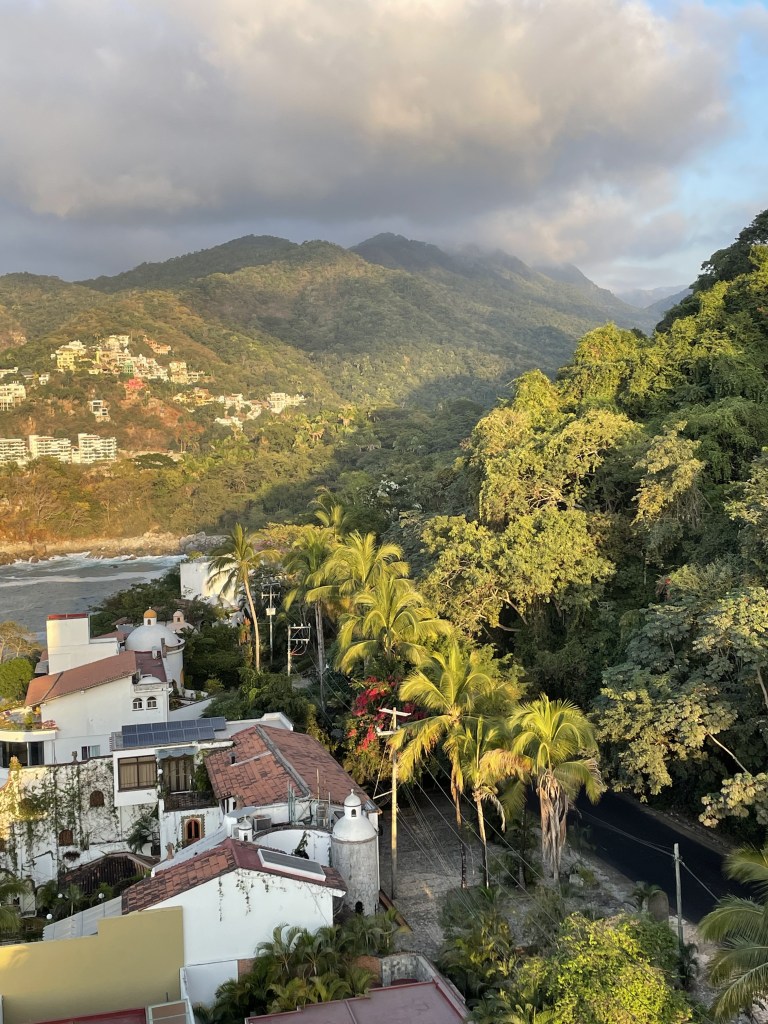
Probably because of its distance from Europe where most Europeans think that Cancun is Mexico, it remains largely undiscovered. There are large swathes of Americans who have retired to places like Ajijic and Manzanillo, in the state of Colima, but once outside some of these areas are hidden gems with beaches, mountains and the most exquisite flora and fauna with huge jungle/forest areas. My friend Kelly has lived here for the past 10 years and travelled the length and breadth of the country, so a great woman to have as a travel companion with every nook and cranny well sussed out.
Mexico has ‘magic towns’, designated as area of interest for tourists. They must meet a minimum standard of hotel availability and suitability, free parking, good internet and be of historic value. We took off to visit some magic towns after Christmas as a way to escape the newly arrived Americans and Canadians who increased the possibility of catching COVID and the terrible flu virus circulating. I’d hate to praise her too much for fear it would go to her head, but I have to admit that Kelly makes a good travel companion as we hit the road to see some of the magic towns.
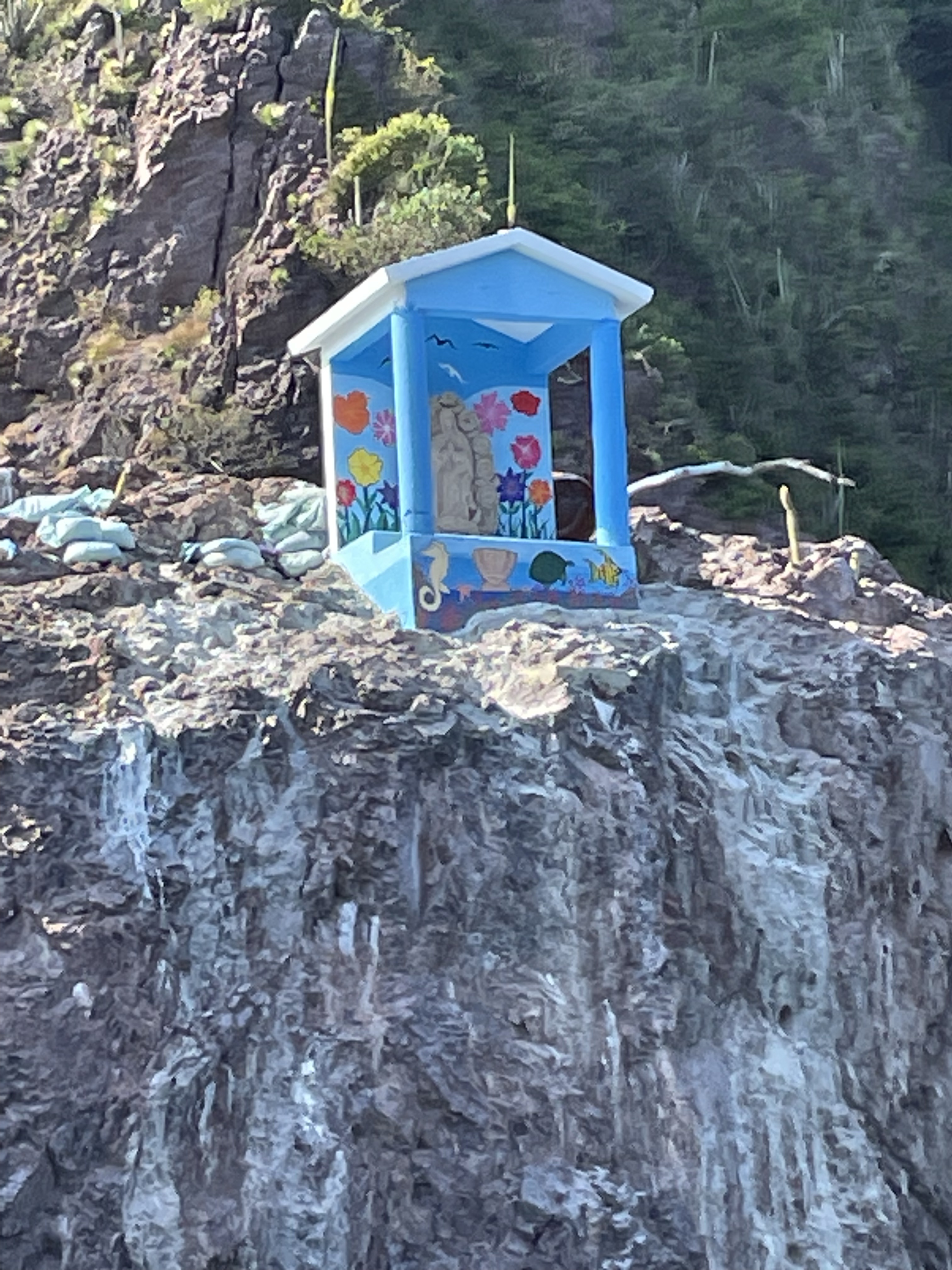
Not only did I not expect such great beauty in the country, but I also didn’t expect the devotion of the average Mexican to the Catholic religion. Coming from Ireland where religion, which was once deeply ingrained in the culture and is now largely passé, I found it both fascinating and impressive. There are saints’ celebrations every other week and religious iconography at every street corner, in every shop and restaurant and in the most unusual places – the side of cliffs, the roadsides and many houses with shrines to the Virgin. December is the feast of the Virgin of Guadalajara and every town and village has either a church dedicated to the Virgin or some sort of shrine. The celebrations are accompanied by firecrackers that go off randomly throughout the day and night, (terrifying most dogs who bark and howl the night away). The Virgin is said to protect the fishing boats going out to sea, so on our day out on a boat, we had to stop on the way out and the way back so the captain and his mate could pay their respects and thank the Virgin for a safe trip.
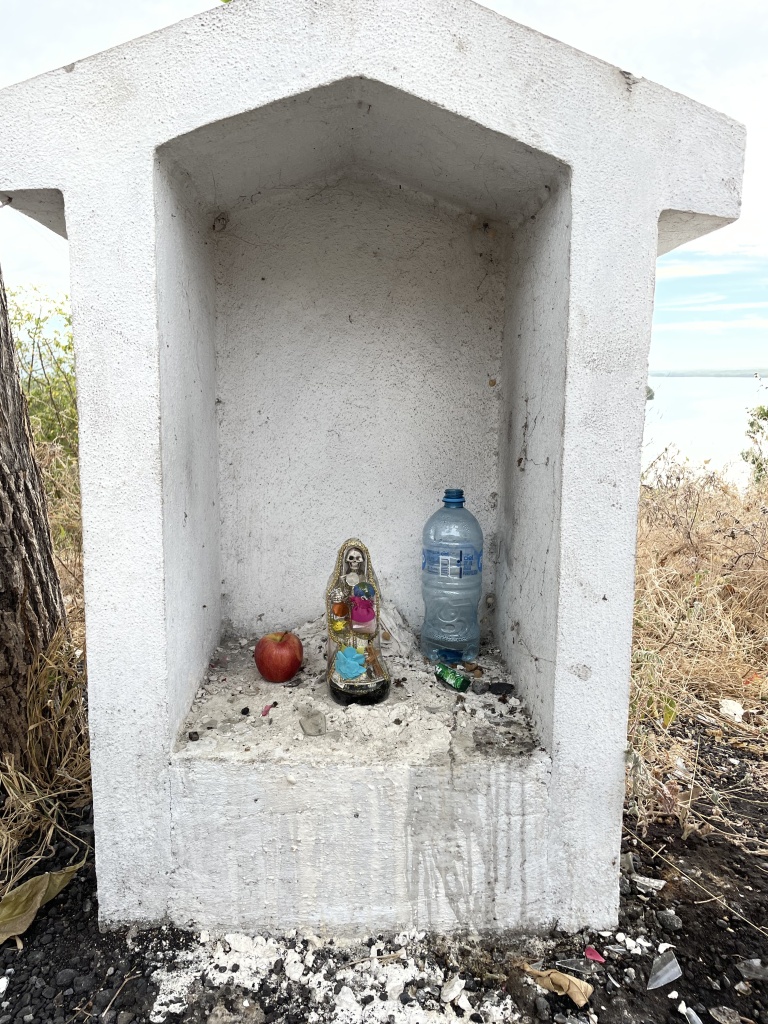
I missed the Day of the Dead, which of course is a huge festival celebrated in Mexico. Graveyards are decorated with Christmas-like decorations and those who passed before us are remembered and celebrated. Travelling with Kelly through San Sebastián del Oeste we came across a graveyard – thinking it was locked up, Kelly was walking away when I realised that the door was could indeed open once you lifted the bolt. We walked in to discover a farmer had left his cows there for grazing, hence the reason for the locked door. The cows looked up when we entered before going back to their job of keeping the graves neat and tidy. I don’t think I’ve seen such ornate graves anywhere and many remained decorated since the November celebrations. One of the weirdest shrines we came across was when we stopped at a truck rest point on the way out of Manzanillo where I wanted to take a photo of the vista below. The small shrine had a skeletal (Day of the Dead) statue where some water, a fresh apple and some candy was left as an offering. We checked with some local friends of Kelly who confirmed that it was some sort of black magic ritual and not what one would expect to see at a roadside truck spot.
By the time I got to Mexico on 1 December, there was a proliferation of nativity scenes – in restaurants, by the roadside, in construction sites and in every town plaza, where hymns and Christmas songs were belted out night and day from speakers. The entrance to a nearby large housing area where we were based had the crib outside the guards’ gate. Many of the baby Jesus statutes§ were dressed in white, sometimes with hand-made crochet dresses, or beautifully embroidered christening gowns. Travelling high in the mountains around Mascota, another travel companion Emily thought she had spotted a zipliner, something I fancied trying. She was convinced it was a zipline because it had a construction similar to what you’d come across if you went to a ski resort. Prior to our arrival at the spot, I realised that it wasn’t a zipline, but rather some electricity wires! The ski hut was in fact a shine to St. Michael the archangel, with a statue of Jesus on the cross. It was rather weird then seeing a glass case with the baby Jesus enclosed wearing rosary beads around his neck – almost as a portend of his future demise. Visiting Thailand, you must see the temples to appreciate the culture… well visiting Mexico it is a must to visit churches to get an insight into some of the culture. In several churches there were life size statues of Jesus in enclosed in glass cases. Apparently, the statues are taken out for parades and brought through the towns and villages as part of the religious processions. One church in Navidad had Jesus in a robe with a long black wig, which momentarily led me to think I was beamed up to Madame Tussaud’s Wax Museum in London town.
As a throwback to the Spanish conquistadores the Three Kings is the big celebration in Mexico whereas in Ireland it signifies the end of Christmas. It was a full week after the 6th of January before the decorations were taken down and the crib dismantled.
The tourist office in the magical town of Mascota recommended we visited a special area with a magnetic field where visitors could be cured of their ills. We walked up the hill in the village of Yerbabuena to the holy area where the holy man was performing some sort of ceremony on the five women who came to visit. It felt as if there was a lot of woo woo going on at the site.
There was a concrete circle with three concrete painted columns and each person had to enter the area barefooted where they faced each column and declared in a loud voice their love and belief in Jesus. Some looked as if they were under a spell as the ‘holy’ man anointed them with oil, mumbled something over them and poked them in the breast and other areas. Kelly has a good command of the Spanish language as she eavesdropped into their conversation about how their aunt/mother/cousin’s daughter had been cured by the holy man. He didn’t want money but pointed them to the donation box. We didn’t consult with the holy man but myself and Emily entered the circle for the cure. Rather than be a hypocrite and profess a belief in Jesus, I silently proclaimed my belief in the power of the universe. Let’s see if I’m cured of my ailments by the time I get home to Ireland.
I have another few weeks to go before my return home and another few road trips to make, including 36 hours in Mexico City. So, for now, hasta luego.
Not only did Santa make it to El Naranjo this Christmas, so did I; and I was very happy to escape the cold winter months in Ireland and the enormous rising costs of heating that came down the track. I’m staying with my friend Kelly who has lived here for a number of years and became involved with the local village, helping out during COVID. Despensas is the Spanish word for pantry and over the last couple of years when COVID destroyed local industry, Kelly fund raised and set up a despensas to help the neediest families in the village with the support of community organisers. I helped out this year and below is the report of the Christmas despensas. I hope you enjoy….more on life in Mexico to follow.
For the third year running, we (the community in Vida del Mar, Las Lomas, Miramar and Santiago Club) were able to help our neighbours celebrate Christmas in the village of El Naranjo. Our fundraising drive came a little later than usual, but thankfully did not disappoint. Thanks go out to our generous food donor Manzanillo Migrant Mission, and to Rich Taylor and Chris Lundgren for stepping in this year to assist with fund raising and also to our donor report publisher in Ajijic.
Shy but very happy with her Christmas gifts
Manzanillo Migrant Mission stepped up to the plate once again (no pun intended) and provided the essentials to help 50 of the poorest families with rice, beans, tuna fish, jalapenos and the much-appreciated packet of coffee and animal crackers, favourites among the residents of El Naranjo. We also distributed chicken stock cubes and washing powder for the families from your donations. Of course, Christmas is all about children, and this year we managed to provide 61 + 7 late-found children with a bag of age-appropriate goodies.
THE GIFTS YOU PROVIDED
All children’s toy bags included Christmas gift bags, juice boxes, drinking bottles, candy bags, toothpaste and toothbrushes, combs and hair brushes and a basket or box to hold their ‘valuables’.
One of many elderly ladies on our list raising a child when their parents are out of the picture.
Gifts by age group
For the youngest girls and boys, we provided baby blankets, bath toys and bathing sponges, stuffed animals, squeeze toys and soft balls. Pre-schoolers also received some combination of play-doh and slime, building blocks, foam swords, spinning tops, toy cars, yoyos, small water pistols, bubble makers, balls, and t-shirts. Paints, crayons and coloring cooks/supplies and story books were also included.
All pre-schoolers and school-aged children got balloons, socks, balls, marbles, yoyos, and water pistols. In addition, there were school supply kits with a pencil bag, spiral notebook, coloring/activity books and coloring pencils/markers or crayons, pens, pencils, erasers, pencil sharpener, scissors and for the older children a folder and activity calendar. There was also a selection of frisbees, table games, watches, animal pillows, paints, story and educational books for the older kids, etc.
The foam sword was out of the bag before you could say ‘on guard
Girls received a selection from Barbie dolls, body spray and body wash, cream, stuffed animals, pony-tail holders, purses, compact mirrors and T-shirts. The older girls also enjoyed an assortment of nail polish, lip gloss, jewellery and handbags. The older boys received activity and puzzle books, soccer balls and sports jerseys.
It took five trips to Manzanillo to acquire sufficient toys to fill the initial 61 toy bags at a cost of $30,955.11 pesos which averaged $507.46 pesos per child for the toy bags distributed on December 21st. The supplemental detergent/bullion bags cost 31 pesos each from donor funds for the 50 families. Luckily the shopping team made it to the stores before the shelves were cleared of suitable toys. With the expectation that some extra children would show up, we packed three extra bags of presents, but that turned out to be too few when we discovered a number of street children without fixed abodes. Not to be forgotten, we are also grateful for the in-kind donations including math workbooks, marbles, jewellery, purses and grooming sets, clothes and the cutest beany toys brought down by car from a very generous donor coming from the States.
VOLUNTEERS
Our long-serving youth volunteer Jenny training her 11-year-old brother Axel to distribute toys
Our community organisers once again rolled up their sleeves and provided us with the lists and the man/woman power to pack the bags, while also providing the space for the main distribution. The distributions would not be possible without the inputs from the community – Gaby (fisherman) and Tonia (former Naranjo mayor), Adriana and her children Jenny and Axel, who between them and some school teachers, shopkeepers and street children know each family and their back story. The truck and car owners who bring the families down from the outskirts of the village to pick up the gift parcels are also a part of this team effort. Our Vida ex-pat helpers provided lessons in bow tying and helped with filling the bags. We are grateful to have the talent of John Chalmers taking a selection of the photos at the distribution. Our Irish visitor assisted with the shopping and while she may look older in years, her inner child provided some useful insights into the choice of toys for the appropriate age groups.
INDIVIDUALS
We saw many of the familiar faces (such as the Old Man on the Mountain’s brother; the coconut vendor on crutches; the meticulous housekeeper for whom your Other Donations added to the meager furnishings of her family’s tent home – her son’s broken arm from a fall has healed, her husband has also healed from a motorcycle accident; and the Chicken Lady who has moved her stand to the front entrance of the primary school) as well as many new faces including disabled children, people living with cancer and a number of street children and semi-nomadic kids without parents.
The Corn Seller with his three children who were extremely pleased with their gifts, with Old Man on the Mountain’s brother on the left and new to the list – twin girls on the right side
Across the road from where the despensas were distributed the ‘Corn Seller’ has a stall beside the bus shelter. A young widower, he has his own three small children and keeps them within his sight while he sells his cooked corn-on-the-cob. He also helps support his late wife’s sister’s children, whose parents are not present. They came early for the parcels, so the team were able to observe the children as they opened the toy bags and spent the remainder of the time during the distribution blowing bubbles with their shouts of laughter drifting across the road above the noise of the traffic. You can help this struggling father by stopping off to purchase corn on your way into Manzanillo.
Christina receiving a Christmas bag for her 4-footed family members
You may remember Christina whose arm was broken and set with pins last year – she had had blood vessels torn in several places from a subsequent fall and came to the distribution with a wheelbarrow and a grandchild in tow. It was news to the team that her 3-year-old grandson was now living with her and it was another situation where we had no toy bag. Christina really wanted to be able to give her grandson a ball so, with a late incoming donation, we made up a bag and dropped it at her house on Christmas Eve. Christina’s arm has healed a bit oddly and she does not have full use of her hands – one is still swollen, but she has returned to clearing land with a machete when she can, and she is an entertainer in a bar but can’t sing now because of throat problems. Christina’s poor diet means she is still anaemic, but is as artistic as ever and her house and street is a marvel of Christmas decoration from salvaged items. It was a lovely sight to see when we called to drop off pet food for the eight stray dogs and five stray cats she is currently taking care of until she finds a home for them.
Chema (the Accountant) and the Flop House –
Chema and his young brother picking up a food bag to help the elderly lady who takes in boys whose parents are absent
Chema was our inventory assistant and bag-stuffing volunteer for the first 2-years of the Naranjo Despensas Project and he is now 13 years old. Chema is now missing school sometimes because he hangs out in the streets despite local mothers trying to coax him back to classes. His mother has drug issues and the aunt who sold street food to support them has since died of a circulatory disease. An elderly woman who lived with the family and who works as a cook at a restaurant until the late hours, has six boys (aged 9-13) without parents flopping at her place,which is in a very poor condition since Chema’s aunt died. We knew about Chema, his younger brother and one other boy at the house, but there were three other street kids we didn’t know about who were left without toy bags when they showed up at the distribution point. The 13-year-old boy started to cry when we had to send him off without a bag. Once the distribution finished we discovered that an 11-year-old boy who was on our list had gone to visit his divorced father in Michoacan so a posse went out on foot, by motorcycle and car searching for the young teenager who got no gifts. We got him a bag of presents 2 days later. We will visit the flop house and see whether we can rustle up some further Other Donations to help them with living necessities.
Disabled Kids
A fragile boy and his sister of about 10 years-old came to the distribution point to personally receive their toys. We were unaware of the children in previous distributions as their hypoplasia bone condition leaves them too weak to stand or leave the house. Two adults helped the kids walk from their special chairs in the back of a pickup truck and held them under the armpits while they came to the counter. The children were clearly thrilled to be there among all the kids. Should there be any leftover donations, we will enquire about acquiring some more appropriate toys for delicate play in a chair or bed as some active play items given are inappropriate.
Jennifer and the plastic lid collection for Kids with Cancer – Jennifer and her family received the first two large deliveries of plastic lids collected here and in the US. The first two filled an SUV and a truck driven down from Washington with lids collected by the Crossroads Rotary members. A third delivery will be made in January as other visitors are bringing bins of lids down from Washington State.
Thanks to the many helpers who deliver lids. This will be the third year we have been participating in the children’s cancer program.
Jennifer with beanie baby toys as part of her gif
Jennifer has grown tall and is looking very healthy at 8-years-old. She still has monthly monitoring and regularly has her port cleaned which has been left in place should she have a relapse, but otherwise she is happy and never complains or feels sorry for herself. Keep saving those lids.
Teenage daughter of breast cancer Victim – You will remember the picture of the 12 year-old girl who was the face of our 2020 toy drive. Her mother was the former community organizer who contracted breast cancer and died this past year so the two daughters went to live with an aunt outside Colima. That situation didn’t work out so the girls (now 15 and 20) are back at their father’s house (the parents divorced years ago) near La Central where they are often left alone, especially at night.The father has alcohol issues and the girls are generally left to fend for themselves.
Former Bus Driver – Many of you will remember the bus driver who lost a leg above the knee last year due to diabetes. Neighbors built a ramp into his house so he can get around by wheelchair. The government finally agreed to pay his social security medical care and he had one eye operated upon. On the day of the distribution he was in day eight of a 30 day recovery period and has difficulty seeing yet. The other eye will be operated on for cataracts in the future. We talked with his wife who, as usual, showed up with a wheelbarrow to help neighbors transport despensas to their home on a faraway street. They now have three dogs and three cats they rescued from the streets in their area.
Heroes DelLa Reforma –
Despensas and gifts were a real help for this family
The man who first informed us of the poverty of this undeveloped area on the edges of El Naranjo came early with his grandchildren. His daughter, who had purpura (blood pooling under the skin and excessive bleeding), died so he is supporting two families now.
Animal Rescuers –
The four kittens dropped off to this house
Before the despensas/toy distribution, we visited the five households that take care of strays (with food and limited medical care) to deliver pet food since they don’t receive outside support. During the drop offs we witnessed a number of dogs and cats with skin problems, mange has likely returned to town, along with eye conditions as well as starving dogs, limping dogs whose legs were broken when they were hit by a car and dogs that require sterilization.
Another home delivery to a late discovery in need.
The 30 Cat Lady now is helping just 13 cats because of poisonings. Stephania currently has 11 cats and eight dogs, two of whom had skin problems and she reported that Animal Angels had helped with six sterilizations. Street Paws, the lady with a special needs daughter who is part of a group of four women across parts of Manzanillo, had a box of four kittens dropped off the night before we visited. She already has eight adult cats, some with eye and skin problems, as well as five dogs. Marta now has eight dogs and 11 cats.
Seven Additional Children
A belated Christmas Eve toy bag put a smile on this mother’s face
There were seven very disappointed children who turned up at the despensas when we distributed on December 21st – from a young 9-month-old baby to several street kids who heard on the grapevine that we were handing out Christmas presents. It was heart-breaking to turn them away when they have absolutely nothing. Tonia, Adriana, Chema and Jenny helped find out where they lived and how many required our assistance. On Christmas Eve we enlisted the assistance of the ever polite and obliging Chema (the Accountant) who came along with us in the car to distribute the toy bags to where the kids lived. We also noted that Chema had to come barefoot to the Christmas distribution. His living situation has continued to worsen since we met him yet he continues to help others. We are open to offers of further assistance for these kids without parents but in the meantime, we used the remaining funds and some more to ensure they have some sort of Christmas.
This young boy got lucky when we were able to made delivery by Christmas Eve with a further donation
The seven new kids were delivered bags filled with soccer balls, candy, a doll, bathing sponges, bubble-maker, toothbrushes and toothpaste, some play-doh or slime, crayons and coloring/story books, toy cars, foam sword, stuffed toys, building blocks, marbles, street chalk and very bouncy balls as well as a couple of pair of socks each. We also provided them with school packs, hoping that it will encourage them to show up to school. They’re very vulnerable and open to all sorts of inappropriate influences on the streets.
INFO BITES
Government Food Basket – the Mexican food basket (corn oil, rice, tuna, pork, chicken and beef, as well as onion, jalapeño pepper, beans, eggs, toilet soap, tomato, milk, lime, apple, orange, sliced bread, potato, pasta for soup, sardines, carrots, corn and wheat flour, white corn, sorghum and wheat) fell in price by 3.4% between October 2021 and 2022 (falling from 1,087 to 1,041 pesos in Guadalajara for the 24 items).
Inflation – Mexican inflation is currently 7.77-8.35% (with/without volatile products) and rose in first two weeks of December after declining for the previous three months (8.41% in October and 7.8% in November). The Bank of Mexico tries to keep inflation in the 2-4% range and is expected to raise lending rates again on 9 February.
Mother and son with a welcome bag of Christmas cheer
Minimum Wage In 2023 the Mexican minimum wage will rise by 20 per cent to 207.44 (€9.44 or US$10.57) pesos per day.
Labor & GDP – The informal economy, those with no benefits, (street vendors, maids/gardeners, retail, construction, agriculture, etc.) accounts for 55.8 per cent of employed Mexicans (up from 21.8 per cent due to the 2020 COVID contraction), but generates 23.7 per cent of earned income. In 2021, GDP grew 4.7 per cent due to the 2.7 per cent increase in the formal economy (manufacturing, government, wholesale trade, etc.)
Despensas – Manzanillo city provided Despensas in December to 1,250 families in greater Manzanillo including El Naranjo.
Carnival/Mardi Gras -is scheduled for February 9-12th ” Viva la Magic” and will have a circus theme with floats, artistic and cultural events, children’s groups, handicrafts, gastronomy, etc. If you prefer to avoid the traffic and crowds, mark your calendars to do your in-town shopping before this.
To the donors who made Santa’s job easier for the residents of El Narjano
Without your generous in-kind and cash contributions we would not have been able to assist some of the poorest families in the area and for that we wish to thank each and every one of you who took the time to support this year’s efforts.
The Corn Seller returned to work by the bus stop and his children were already excitedly playing with their new toys.
I worked as a humanitarian in conflict and post-conflict situations, through famine and the aftermath of earthquakes, typhoons and tsunami. My first mission as a humanitarian was the Indian Ocean tsunami response in Indonesia. This set me off on a course, that I never imagined as a youngster growing up on Dublin’s northside.
In September 2009 I found myself working for the coordination arm of the United Nations in Afghanistan’s capital, Kabul. For the most part, non-government organisation workers and UN staff, lived in guesthouses on small compounds around the city. In the early hours of the 28th October, Bakhtar Guesthouse was attacked by three Taliban. When I stepped into the garden that morning to go for breakfast I became aware of the rat-tat-tat of gunfire. Over the top of the compound walls the billowing smoke rose high into the sky, matching my increasing sense of fear and panic. My stomach knotted and descended into my shoes as I felt the blood drain from my head.
Green Zone, Baghdad, Iraq
Five colleagues, two Afghan security guards and a civilian died that morning.
A stop was put on all staff movement as we went into immediate lockdown, unable to leave the compound. Information on the situation was sparse as senior management scrambled to inform headquarters. The logistics teams went to work to evacuate the injured. Two of my own colleagues jumped from the roof of Bakthar guesthouse to the roof of the neighbouring building, both breaking their ankles.
As the news made headlines across the globe, the TV became our main source of information. There was a sense of frustration not knowing what was happening to colleagues. Real fear that we could be the next target, created tension and incredible stress for the residents inside our compound. Adding to the stress was the fact that the telephone network crashed. Colleagues became desperate to make contact with loved ones at home to reassure they were okay. I seemed to have the only working internet connection so my room turned into the equivalent of an internet café with a queue outside in the first 48-hours after the attack.
Winter, which can be brutal in Afghanistan, hadn’t yet arrived. We gathered each day in the fading rose garden, comforting each other on the loss of colleagues and putting together pieces of information gleaned through various sources. Those afternoons in the garden became therapeutic as we spoke of our grief, our fears and our families at home, all the while transitioning from familiar acquaintances to friends.
Kabul, Afghanistan
My time in Iraq was not so different. In Baghdad we lived on a compound in windowless containers, packed high with sandbags for protection. Each container had a Tannoy that triggered when a rocket was headed in our direction. We were frequently woken by the automated response with a mechanical voice repeatedly shouting “take cover, take cover, take cover.” Our personal protection equipment consisted of a helmet and a 10 kilogramme bullet proof vest, which we dragged to and from work each day. Concrete shelters to provide protection in the event of an attack, dotted the empty roads of the ‘Green Zone’ – the diplomatic area of Baghdad. On more than one occasion I froze in fear lying in bed listening to the rockets land across the Tigris River and thinking they were inside the compound.
Colleagues acted differently to this daily level of stress. Some choose to disengage and rarely left their containers except to go to work. Others choose to gather after dinner in the area outside the canteen known as the piazza, pulling together tables and chairs around the large yellow swing. There we found our tribes and consoled each other when the stress of living in confinement and fear became overbearing.
Being confined to barracks in Ireland is somewhat different to lockdown in Iraq or Afghanistan. There is the pure luxury of an early morning walk when the sun is re-introducing itself, as it slithers around Howth Head when I march down the Clontarf seafront. Daily meditation helps me cope with the fear of Covid-19 and I increasingly appreciate the safe space my own home provides. When I lived in Kabul, my wise Australian colleague and friend would take out her lipstick when the going got tough. She believed that when we had our lipstick on, we could put the world to rights. Before I step outside the door each morning to take my walk, I take out my brightest red lipstick and apply liberally.
My contract in Nigeria finished in January so I left a few days before Christmas, taking all my holidays. I was happy to leave in one sense, the constant human misery in the north was taking its toll but I have to admit I was more than a bit torn; there was also a part of me that wanted to go back and help highlight this crisis for the 5 million plus people facing starvation. Five million people – that’s more than the population of Ireland. Trying to create interest in the humanitarian situation was difficult in Nigeria itself, let alone among the international community.
The decision to return was taken out of my hands so with a three month break under my belt, it almost came then as a bit of ‘light’ relief to find myself boarding a plane back to The Stan (Afghanistan) after a seven-year absence. Memories merge in my brain between my time in Afghanistan and Iraq, another duty station where freedom of movement is restricted because of insecurity. I can hardly complain about the tight security in Afghanistan considering there was sweet fanny adams in terms of security measures in place in northern Nigeria where Boko Haram, the local jihadi group, run riot.
There are a few differences; in Kabul I don’t have to negotiate traffic each day as I did in Nigeria. We live and work on the same compound. I reckon it’s probably less than 100 steps between the living quarters, small restaurant and the office – it takes just three minutes to walk the inside perimeter.
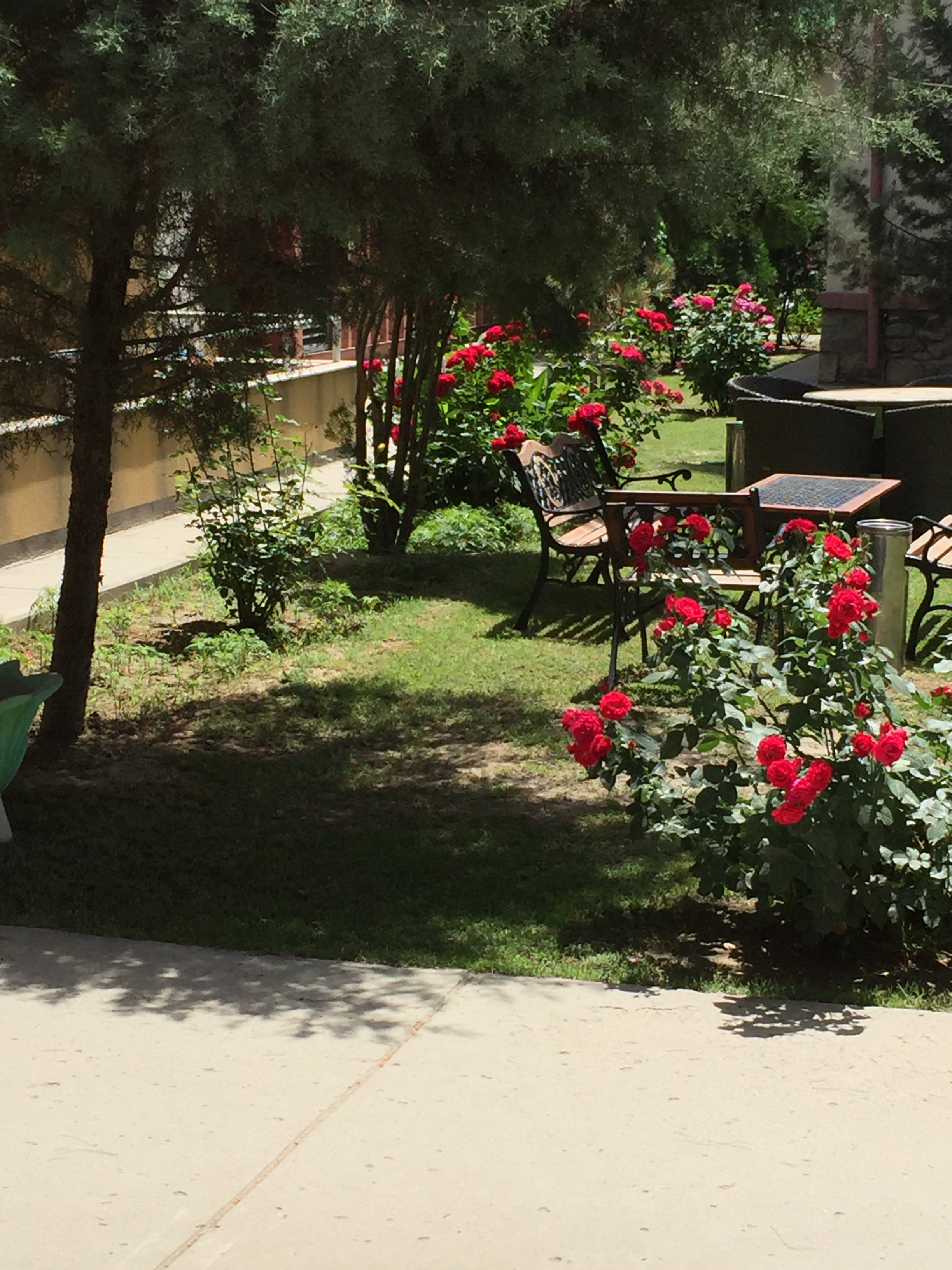
Afghans love roses and there are plenty in the summer
I can’t make up my mind whether the compound is more like living in an open prison, a convent or a home for alcoholics as there is zero booze to be had in country at the moment and the people coming back from their R&R are welcomed with open arms by inmates almost emptying out their suitcase on arrival. Nigeria in comparison has no taxes on alcohol; so the excellent South African wines were at giveaway prices. If you compare accommodation in Kabul it’s a thousand times better than anything in Nigeria – the compound is located in the former Dutch Embassy – (the Dutch couldn’t afford the horrendous rents that come with war zones, so the UN took it over). There is a small restaurant where lunch is around $5. There’s also a pool and decent gym in the basement.
The gym is unavailable to women between 4.30 and 7.30 pm when the local male staff have access. In this supposedly deeply conservative society it’s not kosher for men to see any part of a woman’s body. My preference is to rise early, usually by 5.30 a.m. and be in the gym by 6 a.m. It’s all about timing and routine – the cup of green tea, checking the emails… if I miss my imaginary deadlines it just upsets me for the day. The boss decided to call a very early morning meeting not so long ago, upsetting my timetable resulting in a missed exercise schedule. I skipped (figuratively not literally) out of the office during lunchtime to catch up. The national female staff began pouring in and the door, normally left open, was firmly shut behind them. They arrived in long coats and scarves and disrobed once inside mostly to reveal regular gym gear under the coats. Scarves were whipped off as they inspected hair and makeup in the mirror, and preened themselves before their workout! One or two had pinafores over the gym clothes, which always looks strange to me to see somebody on a treadmill in full garb.
There are several UN compounds scattered around the city, the furthest being on the Jalalabad Road out towards the airport. It’s one of the most dangerous roads in the world with horrendous traffic and there are plenty of opportunities for bad people to attach magnetic bombs to cars while stuck in traffic. One of our own staff members was driving to work not so long ago when a suicide bomber across the road decided to blow himself up and while my colleague was thankfully unharmed, he was very upset that there wasn’t a window left on his car.
Most of my journeys around Kabul involve going to and from meetings. I can understand why there is an R&R cycle to allow people a break after six weeks of living in lockdown! The lack of freedom of movement gets to you after a while so even being stuck in traffic allows you to observe life and I could happily sit for hours in a traffic jam (albeit always looking over my shoulder) and just watch people and behavior. What’s fascinating though is to watch the traffic at roundabouts – there are no rules. Rather than taking the third exit off a roundabout, it’s normal to see cars just going in the opposite direction to take the shortest route possible. Like many other countries in the region, it’s not unusual either to see a car careering down a highway travelling in the opposite direction to every other car on the highway so you need nerves of steel.
The general security situation hasn’t improved much in the seven years, a recent report says there were more people killed last year in Afghanistan than Syria and that’s saying something. It is believed that the BigT (Taliban) has control of more than 40 per cent of the country and there doesn’t appear to be abatement in the numbers of insurgents or their strength. The Americans and British are still around and the sound of military Chinoook helicopters crossing the skies several times a day can be heard long before they’re seen in Kabul. The US picked the Easter weekend to target the ‘mother of all bombs’ in the east of the country where they believe ISIS to be hiding out in caves – no doubt increasing the likelihood of counter attacks on foreigners. I have a few friends who live out in the compound close to the airport and sometimes I take the work-shuttle to go and hang out on a weekend. This is much more like a village than a compound, although still surrounded by t-walls and heavily secured. Sitting outside with an Irish friend, eating pizza I noticed that many of the aircraft flying over the compound had no lights.… a little bit worrying. My friend pointed out that these were military planes and in fact when you looked up as they passed over, the bombs attached to the underbelly were clearly visible.
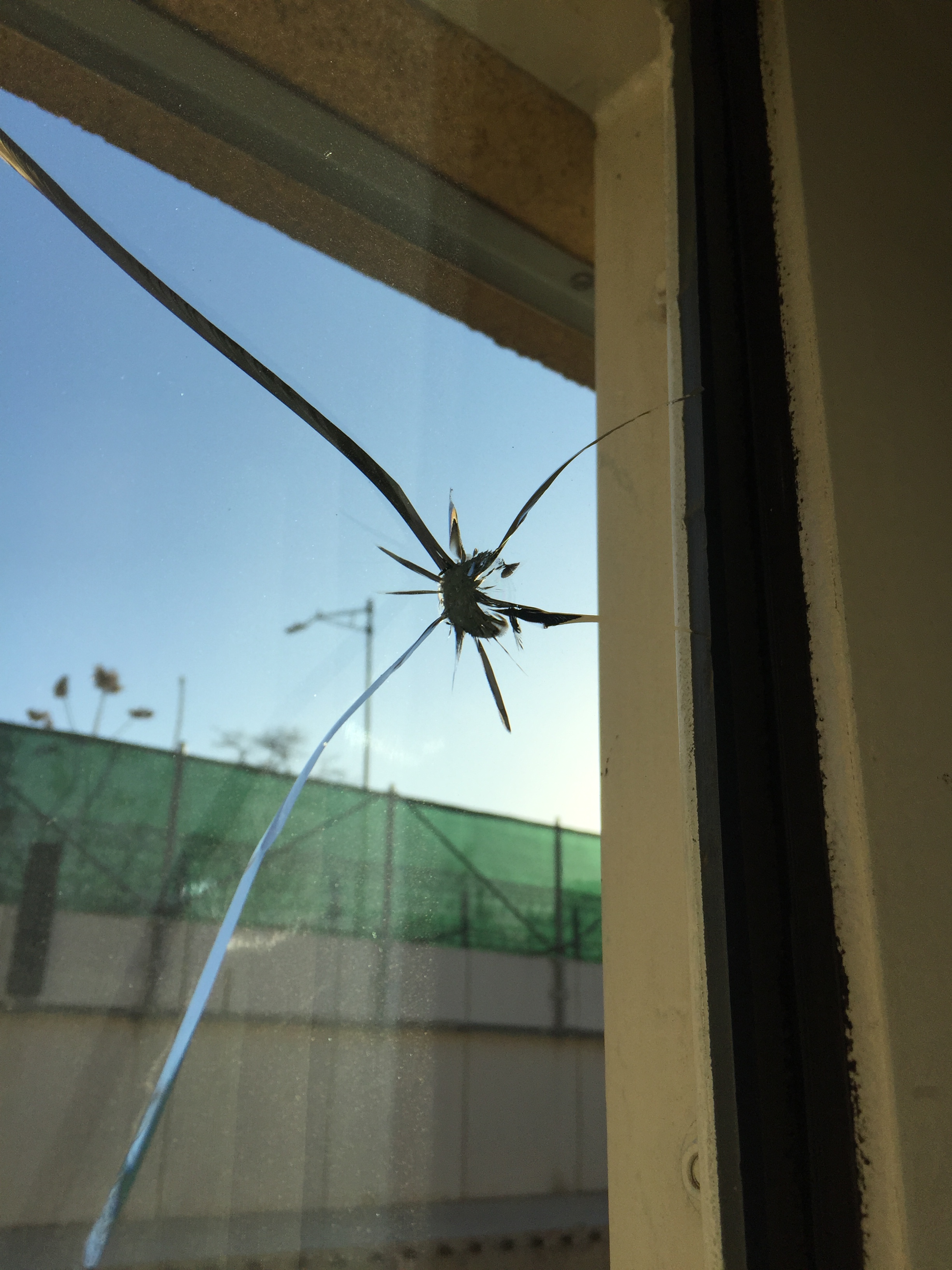
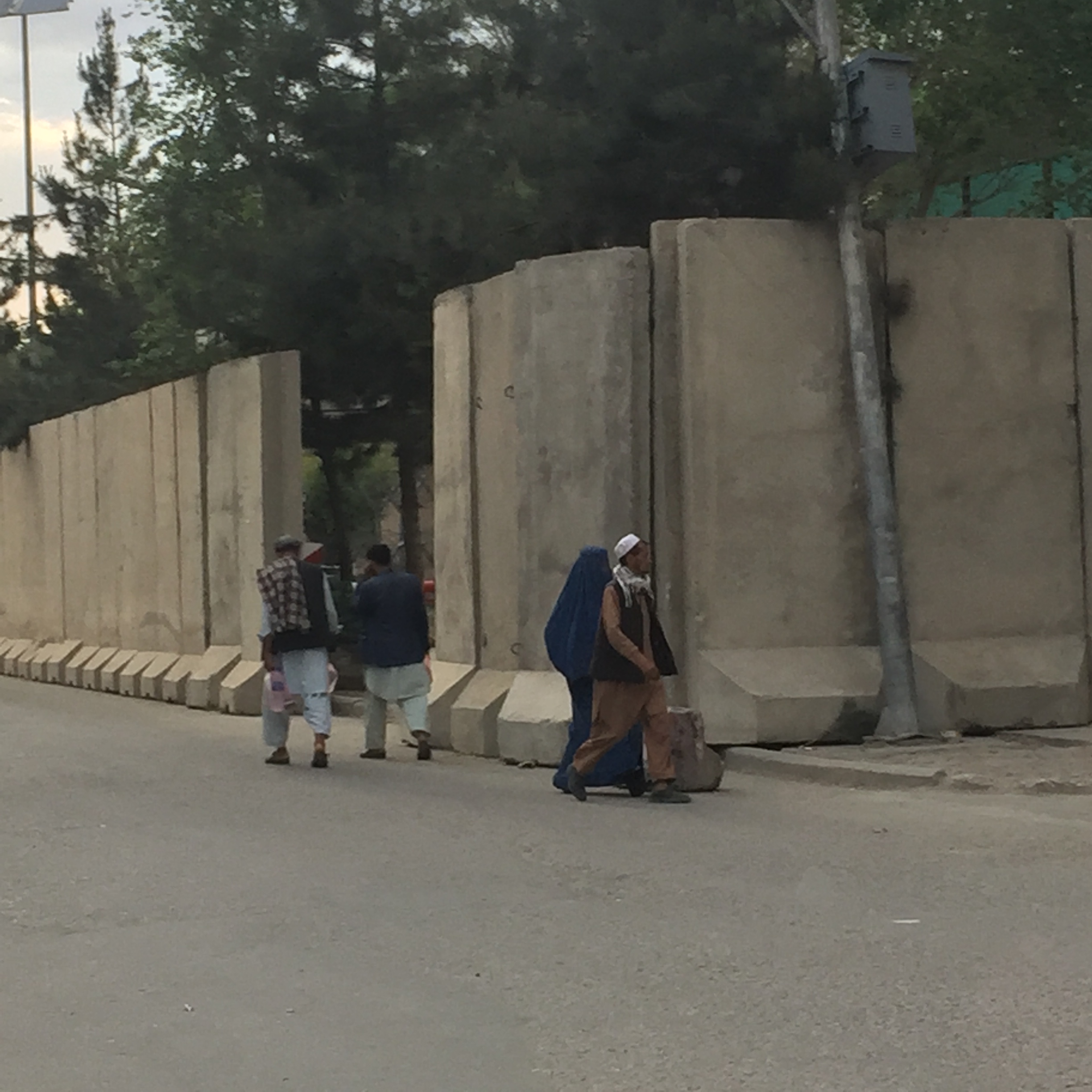
While life goes on, Kabul is still a city under siege. Since my last visit, it’s striking the increase in the number of t-walls that surround buildings, blocking them to the average citizen and giving a very strange atmosphere to the city. The t-walls are mainly protecting Government buildings, NGOs, embassies and UN compounds. Of course apartment buildings where the ordinary Afghani lives, (if they are lucky not to be stuck in a tent somewhere), don’t have the luxury of t-walls and hence very little protection – it’s impossible to get a sense of the architecture though around the city centre. In the compound where I live, there are regular drills to the bunkers and the doors on each accommodation room is Taliban-proof so you can’t leave the key in the lock or it will take security an hour to drill through if they need to gain entry in an emergency. The windows are also bullet proof (see photo of my room with the cracked glass – I’m not even going to think how that got there). While you try to live or pretend that you live a ‘normal’ life, there is always something that brings you down to earth and reminders that this is a very abnormal life and situation.
Bullet holes in my room window
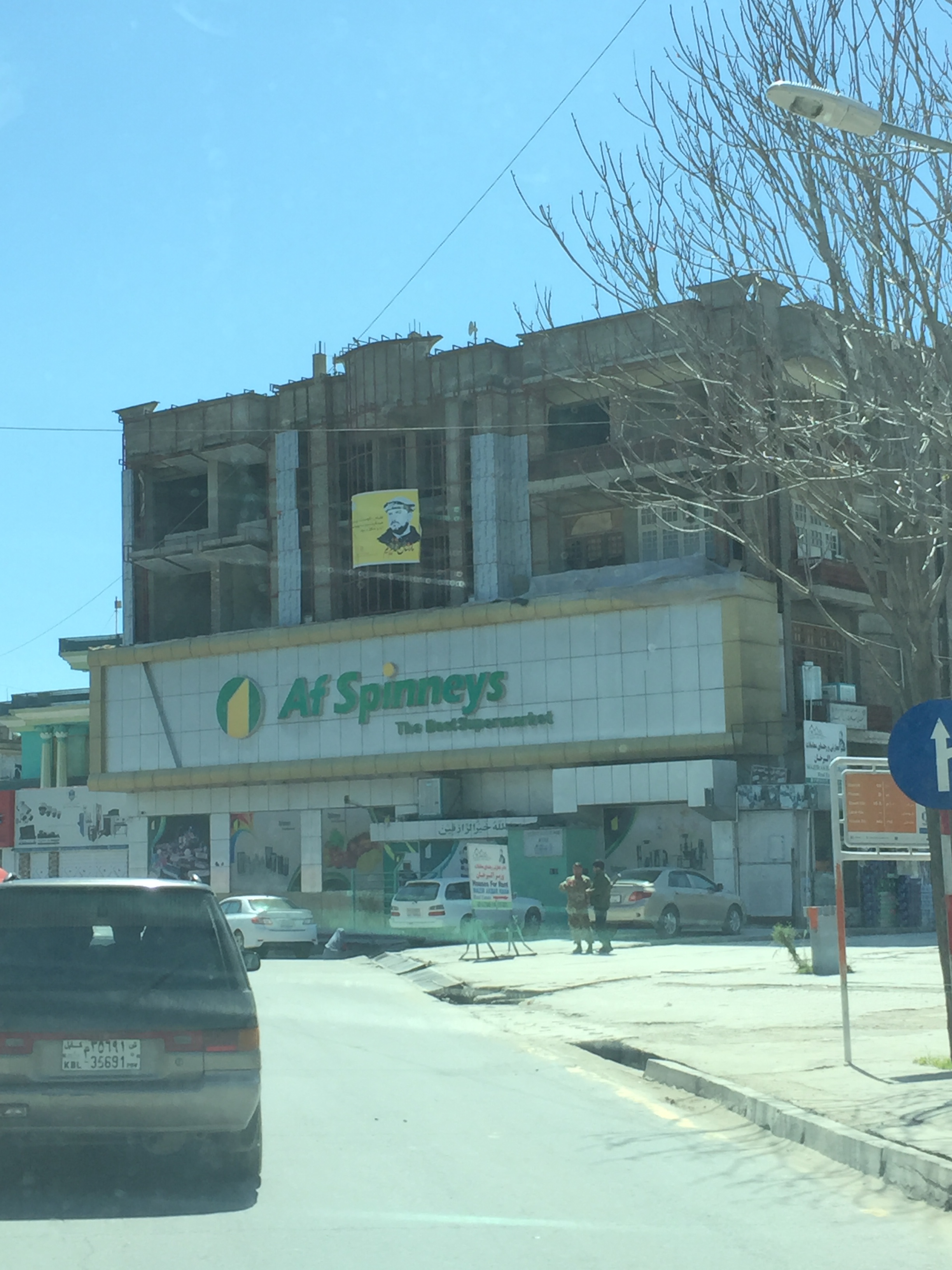
We’re allowed to visit Spinneys and Finest supermarkets but can stay no longer than 20 minutes. Back in 2009/2010 these supermarkets had windows and I remember a time coming up to Christmas there was a mannequin of Santa Claus in the window ‘playing’ a saxophone. I think the BigT were more than a bit pissed off with that because there was a major attack on Finest in 2011 and eight people lost their lives. Now, the windows are boarded up and going into the supermarket is the nearest thing to boarding a flight these days, where you’re frisked and your bags are searched on the way in. Almost everything you need can be bought in the supermarkets, okay there is difficulty in accessing pork (but I’m not a big fan), however most other things including the big brands are easily available – even some decent Irish cheddar cheese. Magnum ice creams are a nice treat for a Friday afternoon, the first day of the weekend.
The supermarkets for foreigners are more like fortresses
Around the city, there are many more burka-less women about and about. Indeed, it’s not unusual to see women without male escorts, although a colleague informed me that single women out on their own on the streets are generally hissed at as if they are prostitutes. Remember that Kabul is a city where women wore mini-skirts in the 60s and 70s. There also seems to be many more girls at school, identified by their black uniforms and white headscarves. When I was here seven/eight years ago it was really unusual to find women out on the streets at all and you would mainly see them first thing in the morning going to work as cleaners. Just a week ago there were women sweeping the streets outside the compound and an Afghan female colleague said it was the first time she witnessed women working outdoors. Change is slowly coming, but I’m not so sure that women’s ‘liberation’ has moved much beyond the centre of Kabul. Once out on the Jalalabad Road, most of the women wear burkas so I can only imagine this phenomena is unique in the city.
Kabul, a city of T-walls
There is no doubt that women have a tough life in Afghanistan and I for one am very glad I wasn’t born here. Shamshia cleans my room and brings me some of the local flat bread three days a week. She had a nasty fall at work and her arm was bandaged up so she had to take a week off, but returned with the arm still in bandage to continue working. I felt so guilty about her having to work with a strapped up arm that I began cleaning my own room to give her hand out. Now Shamshia calls with bread and I get a big hug and a kiss on each cheek three times a week. Somehow I don’t think the contractor provides sick pay for staff. While I wouldn’t envy Shamshia’s lot, she at least has a job unlike the poor unfortunates who are begging, walking up and down between cars on the roads.
In 2015 I went to the regional consultations for the World Humanitarian Summit in Tajikistan. There was a gender meeting, mainly about women and women’s rights. In the middle of the meeting a professor from the University of Kabul stood up and announced that everything was okay in Afghanistan before these women started looking for an education. Everybody was so shocked the room went silent. I’d like to report that men’s attitudes have changed, but I find little evidence and not much evidence among the national male colleagues either. A work colleagues has a brother who works in the Ministry of Religious Affairs. Each year Afghanistan gets an allocation of 10,000 places on the Haj so places are prized and people make the pilgrimage one in their lifetime. However, it’s the Ministry of Religious Affairs that allocates the places so this guy (Haj 3) has been to Mecca, yes, three times. He’s on the look out for a second wife, the first is probably worn out with the eight children she produced for him. Our driver supports 11 members of his family on his salary; he’s just a young fella with five kids of his own. Apparently his house was burnt down a while back by somebody pouring petrol through the door. They mistook his house for his landlords who it is believed shot a man in revenge for some petty incident. Life is not only interesting in Afghanistan but also cheap!
And on that not so cheery note I will sign off for now. I head to Erbil in a few weeks on another contract, which should see me through until the end of the year. So until Erbil, it’s Oscar Romeo Lima Alpha over and out from Kaboom.
Why cycle when you can bring your bicycle on a motorbike?
Sunset over the Hindu Kush mountains
The Fort in Kabul
Wedding season before Ramadan
Balloons for children
Women are not generally visible around Kabul
Roundabouts Kabul style
Kabul is surrounded by the Hindu Kush mountains
Graffiti Kabul
Fashion Afghan style
Modern apartments in the cty
Chickens couldn’t come more fresh than this
Not unusual to find donkey and carts in the capital
Orla Fagan is spokesperson for the United Nations Office for the Coordination of Humanitarian Affairs (OCHA) in studio with Richard Crowley on RTE Radio 1 during the week.











 FagansBlog